Jensen Huang Resigns as Nvidia CEO; Bitcoin Falls Below $72,000
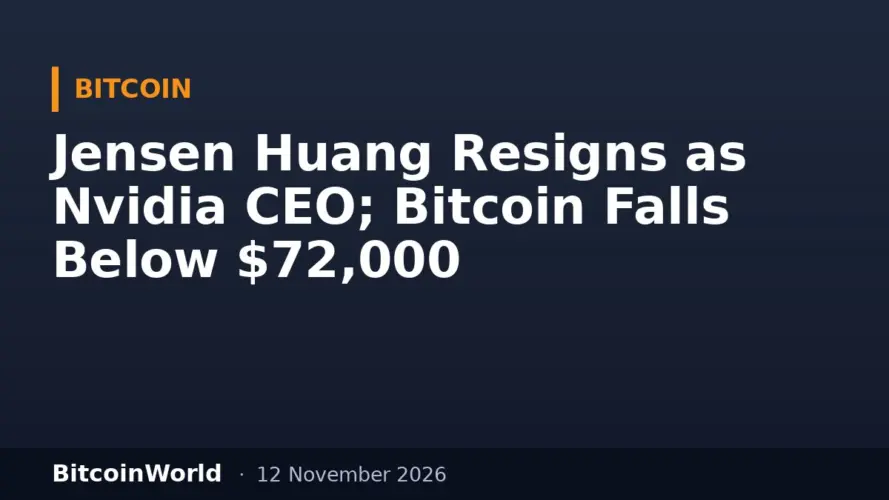
Jensen Huang resigned as Nvidia's CEO effective immediately, sending shares down more than 13% and dragging bitcoin below $72,000 as AI-linked risk assets sold off in tandem.

In this article
Editor’s take (Keshav Aggarwal): I see Jensen Huang’s resignation as bad for the entire industry, and I think the board’s decision was wrong; comparing his personal and professional life is unfair after 33 years. For small crypto investors, I’d wait because interest-rate decisions are just around the corner.
Jensen Huang resigns as Nvidia’s president, chief executive and board member effective immediately, the company said on Thursday, a leadership shock that sent the chipmaker’s shares down more than 13% at the US market open and pulled bitcoin below $72,000 in a broad risk-asset selloff.
Bitcoin traded at $71,421.92 at 15:20 UTC, down 3.7% over 24 hours and 6.3% over seven days, according to CoinPaprika data, 43.5% below its all-time high of $126,173. Ether changed hands at $2,001.44, down 3.73% on the day and 11.35% on the week. The total crypto market cap fell 2.8% to $2.49 trillion on $102.4 billion of 24-hour volume, with bitcoin dominance at 57.56%.
Jensen Huang resigns: what Nvidia announced
Nvidia named chief financial officer Colette Kress interim CEO while she retains the CFO role, and appointed Harvey C. Jones, former chief executive of chip design software firm Synopsys, as its first-ever board chair. Huang, 63, co-founded Nvidia in 1993 and ran it for 33 years.
“The Board has full confidence in Colette and the leadership team, and we expect the company’s operations, customer commitments and product roadmap to continue without interruption,” Jones said. Kress said she was “committed to building on the extraordinary foundation Jensen created over the last 33 years.”
The company did not give a reason for the exit. Nvidia said it will report fiscal 2027 third-quarter results as scheduled on Nov. 17.
Why Jensen Huang resigns
The resignation came four days after Huang told staff in a letter that he had been unfaithful to his wife, prompting the board to open an independent investigation. The New York Times reported that Huang had told directors he was intimate with Alice Huang, an executive at Singapore-based Megaspeed, an Nvidia customer; the Times had reported in October that US officials concluded she was a Chinese intelligence asset. China has denied the allegations.
On Wednesday the Times reported a second relationship, with Kimberly Powell, Nvidia’s vice president of health care, who reports to Huang, and the Wall Street Journal reported the board was preparing to remove him. Nvidia’s board initially defended Huang and announced an independent investigation into whether he had been targeted by a foreign intelligence operation; on Nov. 8 it said it had no reason to believe national security or confidential company information was compromised. The company did not give a reason for the resignation. The scandal had already erased roughly $430 billion of Nvidia’s market value in two days earlier this week, and the company and Huang face a proposed shareholder class action. Huang remains Nvidia’s largest shareholder with a stake of about 3.6%, according to the Journal.
How an AI-chip shock reaches crypto
The transmission channel is the AI trade itself. Nvidia is the benchmark holding for artificial-intelligence exposure, so a governance shock at the top forces portfolio managers to cut correlated risk first and ask questions later. Nasdaq 100 futures fell about 1% on Thursday, according to crypto.news; Nvidia traded at $151.00 by 13:31 UTC after touching $148.80, Yahoo Finance data cited by Cointelegraph and Decrypt shows, while AI-infrastructure name CoreWeave dropped about 6% in after-hours trading. Rival chipmakers AMD and Broadcom gained roughly 4% and 3% respectively, a sign of rotation rather than outright exit.
Crypto sits at the high-beta end of that same trade. Hilbert Group chief investment officer Russell Thompson warned that further losses in AI and semiconductor stocks could force investors to liquidate crypto holdings to meet margin calls, identifying $71,900 as an important support level and a potential slide toward $65,000 if bitcoin fails to hold it.
Listed bitcoin miners have deepened the link by pivoting into AI data centers. BlocksBridge Consulting estimated a roughly $50 billion funding gap across planned projects in June, and public companies sold 108,247 BTC worth about $8.08 billion during 2026, according to Lookonchain, with MARA Holdings and Riot Platforms accounting for more than half.
Ether and major alts slide
The decline was broad rather than isolated to bitcoin.
| Asset | Price | 24h | 7d |
|---|---|---|---|
| Bitcoin | $71,421.92 | -3.70% | -6.29% |
| Ether | $2,001.44 | -3.73% | -11.35% |
| XRP | $1.02 | -4.72% | -18.39% |
| Solana | $80.84 | -4.76% | -10.85% |
| BNB | $652.01 | -4.90% | -5.89% |
| TRON | $0.3155 | -0.33% | -0.19% |
Stablecoin turnover tells the same story: Tether’s 24-hour volume of $38.2 billion dwarfed bitcoin’s $17.5 billion, a footprint consistent with holders moving to the sidelines rather than rotating between tokens. The Crypto Fear & Greed Index slipped to 28, still in “Fear” territory, from 29 a day earlier. TRON was the outlier among large caps, down 0.33% over 24 hours and 0.19% on the week, while Zcash fell 23.6% over seven days and XRP 18.4%.
What to watch next
- The permanent CEO search. Nvidia’s board is weighing internal and external candidates, with the Financial Times citing data center chief Ian Buck and Arm CEO Rene Haas, a former Nvidia executive, among possible options. Huang ran the company with about 60 executives reporting directly to him and has said he did not believe in succession planning.
- Nov. 17 earnings. Kress will present fiscal 2027 third-quarter results with an interim title and a board chair installed days earlier; guidance on AI infrastructure commitments, including a 20-year data center agreement involving OpenAI, will carry more weight than usual.
- Whether the AI-to-crypto correlation holds or decouples. If Nvidia stabilizes and bitcoin keeps falling, ETF outflows and crypto-specific positioning are driving the move; if both recover together, the AI trade is still the master variable. Sustained withdrawals from US spot bitcoin ETFs, noted by crypto.news, are the tell.
For now, bitcoin is trading below the $71,900 level Thompson flagged. If bitcoin fails to reclaim $71,900, the $65,000 area he outlined comes into view; a move back above $71,900 would suggest the market is pricing a Nvidia-specific event rather than a broader unwind of the AI trade.
Frequently asked questions
Why did Jensen Huang resign as Nvidia CEO?
Nvidia did not give a reason. The resignation came four days after Huang told staff he had been unfaithful to his wife, prompting a board investigation, and after reports of a second relationship with an Nvidia vice president. Those reports are unconfirmed.
Who is running Nvidia now?
Chief financial officer Colette Kress is interim CEO while keeping the CFO role. Former Synopsys chief executive Harvey C. Jones was named the board's first-ever chair, and Nvidia says it will report quarterly results on Nov. 17 as scheduled.
Why did bitcoin fall when Nvidia's CEO resigned?
Nvidia is the benchmark holding for AI exposure, so a shock there forces investors to cut correlated risk. Crypto sits at the high-beta end of the same trade, and the decline was broad rather than isolated to bitcoin.
Sources: Decrypt, Cointelegraph, crypto.news
Keshav Aggarwal
Keshav Aggarwal is the Co-Founder and Responsible Editor of BitcoinWorld, a publication covering crypto, AI, and forex markets since 2020. A blockchain investor and trader with over six years in the digital-asset space, he built one of India's most active crypto investor communities and has guided thousands of retail participants through their first investments in the asset class. At BitcoinWorld, he sets editorial direction across the newsroom and reports on the business of crypto, AI, and Web3 - tracking the funding rounds, product launches, and regulatory shifts shaping the future of finance and frontier technology.